

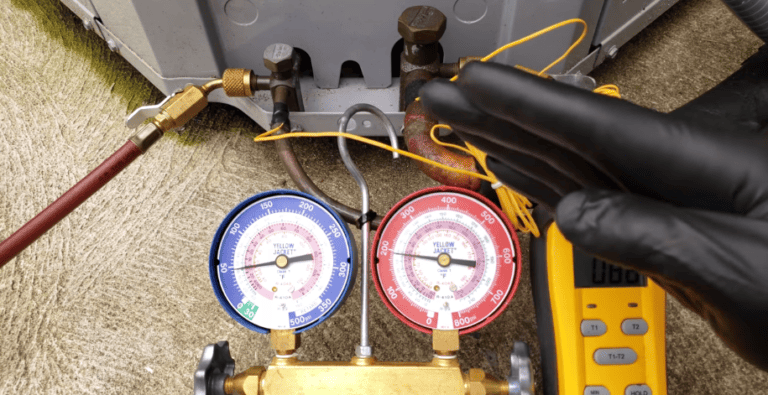
What are 410a pressures on a 95 degree day?
The typical 410a pressures on a 95 degree day are as follows;
Liquid pressure: 296.4 psi
Vapor pressure: 295.5 psi
See all other pressures for R410 on different temperatures of the day from -49°F to 150°F below.
R410a Pressure Chart High and Low Side
| Temp(°F) | Liquid Pressure (psi) | Vapor Pressure (psi) |
| -49 | 5.5 | 5.4 |
| -48 | 6.0 | 5.9 |
| -47 | 6.6 | 6.5 |
| -46 | 7.1 | 7.1 |
| -45 | 7.7 | 7.6 |
| -44 | 8.3 | 8.2 |
| -43 | 8.9 | 8.8 |
| -42 | 9.5 | 9.4 |
| -41 | 10.1 | 10.0 |
| -40 | 10.8 | 10.7 |
| -39 | 11.4 | 11.3 |
| -38 | 12.1 | 12.0 |
| -37 | 12.7 | 12.6 |
| -36 | 13.4 | 13.3 |
| -35 | 14.1 | 14.0 |
| -34 | 14.8 | 14.7 |
| -33 | 15.6 | 15.5 |
| -32 | 16.3 | 16.2 |
| -31 | 17.1 | 16.9 |
| -30 | 18.6 | 17.7 |
| -29 | 21.0 | 18.5 |
| -28 | 21.9 | 19.3 |
| -27 | 22.7 | 20.1 |
| -26 | 23.6 | 20.9 |
| -25 | 24.5 | 21.8 |
| -24 | 25.4 | 22.6 |
| -23 | 23.6 | 23.5 |
| -22 | 24.5 | 24.4 |
| -21 | 25.4 | 25.3 |
| 20 | 26.3 | 26.2 |
| -19 | 27.3 | 27.1 |
| -18 | 28.2 | 28.1 |
| -17 | 29.2 | 29.0 |
| -16 | 30.2 | 30.0 |
| -15 | 31.2 | 31.0 |
| -14 | 32.2 | 32.0 |
| -13 | 33.2 | 33.1 |
| -12 | 34.3 | 34.1 |
| -11 | 35.4 | 35.2 |
| -10 | 36.5 | 36.3 |
| -9 | 37.6 | 37.4 |
| -8 | 38.7 | 38.5 |
| -7 | 39.9 | 39.7 |
| -6 | 41.0 | 40.8 |
| -5 | 42.2 | 42.0 |
| -4 | 43.4 | 43.2 |
| -3 | 44.6 | 44.4 |
| -2 | 45.9 | 45.7 |
| -1 | 47.1 | 46.9 |
| 0 | 48.4 | 48.2 |
| 1 | 49.7 | 49.5 |
| 2 | 51.1 | 50.8 |
| 3 | 52.4 | 52.2 |
| 4 | 53.8 | 53.5 |
| 5 | 55.2 | 54.9 |
| 6 | 56.6 | 56.3 |
| 7 | 58.0 | 57.8 |
| 8 | 59.5 | 59.2 |
| 9 | 60.9 | 60.7 |
| 10 | 62.4 | 62.2 |
| 11 | 63.9 | 63.7 |
| 12 | 65.5 | 65.2 |
| 13 | 67.1 | 66.8 |
| 14 | 68.6 | 68.4 |
| 15 | 70.3 | 70.0 |
| 16 | 71.9 | 71.6 |
| 17 | 73.5 | 73.3 |
| 18 | 75.2 | 74.9 |
| 19 | 76.9 | 76.6 |
| 20 | 78.7 | 78.4 |
| 21 | 80.4 | 80.1 |
| 22 | 82.2 | 81.9 |
| 23 | 84.0 | 83.7 |
| 24 | 85.8 | 85.5 |
| 25 | 87.7 | 87.4 |
| 26 | 89.6 | 89.2 |
| 27 | 91.5 | 91.1 |
| 28 | 93.4 | 93.1 |
| 29 | 95.4 | 95.0 |
| 30 | 97.4 | 97.0 |
| 31 | 99.4 | 99.0 |
| 32 | 101.4 | 101.1 |
| 33 | 103.5 | 103.1 |
| 34 | 105.6 | 105.2 |
| 35 | 107.7 | 107.3 |
| 36 | 109.9 | 109.5 |
| 37 | 112.1 | 111.7 |
| 38 | 114.3 | 113.9 |
| 39 | 116.5 | 116.1 |
| 40 | 118.8 | 118.4 |
| 41 | 121.1 | 120.7 |
| 42 | 123.4 | 123.0 |
| 43 | 125.8 | 125.3 |
| 44 | 128.2 | 127.7 |
| 45 | 130.6 | 130.1 |
| 46 | 133.0 | 132.6 |
| 47 | 135.5 | 135.0 |
| 48 | 138.0 | 137.5 |
| 49 | 140.6 | 140.1 |
| 50 | 143.2 | 142.6 |
| 51 | 145.8 | 145.2 |
| 52 | 148.4 | 147.9 |
| 53 | 151.1 | 150.5 |
| 54 | 153.8 | 153.2 |
| 55 | 156.5 | 156.0 |
| 56 | 159.3 | 158.7 |
| 57 | 162.1 | 161.5 |
| 58 | 164.9 | 164.4 |
| 59 | 167.8 | 167.2 |
| 60 | 170.7 | 170.1 |
| 61 | 173.7 | 173.1 |
| 62 | 176.7 | 176.0 |
| 63 | 179.7 | 179.0 |
| 64 | 182.7 | 182.1 |
| 65 | 185.8 | 185.2 |
| 66 | 188.9 | 188.3 |
| 67 | 192.1 | 191.4 |
| 68 | 195.3 | 194.6 |
| 69 | 198.5 | 197.8 |
| 70 | 201.8 | 201.1 |
| 71 | 205.1 | 204.4 |
| 72 | 208.4 | 207.7 |
| 73 | 211.8 | 211.1 |
| 74 | 215.2 | 214.5 |
| 75 | 218.7 | 217.9 |
| 76 | 222.2 | 221.4 |
| 77 | 225.7 | 224.9 |
| 78 | 229.3 | 228.5 |
| 79 | 232.9 | 232.1 |
| 80 | 236.5 | 235.8 |
| 81 | 240.2 | 239.4 |
| 82 | 240.2 | 239.4 |
| 83 | 247.8 | 246.9 |
| 84 | 251.6 | 250.7 |
| 85 | 255.4 | 254.6 |
| 86 | 259.3 | 258.5 |
| 87 | 263.3 | 262.4 |
| 88 | 267.3 | 266.4 |
| 89 | 271.3 | 270.4 |
| 90 | 275.4 | 274.5 |
| 91 | 279.5 | 278.6 |
| 92 | 283.6 | 282.7 |
| 93 | 287.9 | 286.9 |
| 94 | 292.1 | 291.2 |
| 95 | 296.4 | 295.5 |
| 96 | 300.7 | 299.8 |
| 97 | 305.1 | 304.2 |
| 98 | 309.5 | 308.6 |
| 99 | 314.0 | 313.1 |
| 100 | 318.6 | 317.6 |
| 101 | 323.1 | 322.1 |
| 102 | 327.7 | 326.7 |
| 103 | 332.2 | 331.4 |
| 104 | 337.1 | 336.1 |
| 105 | 341.9 | 340.1 |
| 106 | 346.7 | 345.7 |
| 107 | 351.6 | 350.5 |
| 108 | 356.5 | 355.4 |
| 109 | 361.4 | 360.4 |
| 110 | 366.4 | 365.4 |
| 111 | 371.5 | 370.4 |
| 112 | 376.6 | 375.5 |
| 113 | 381.8 | 380.7 |
| 114 | 387.0 | 385.9 |
| 115 | 392.3 | 391.2 |
| 116 | 397.6 | 396.5 |
| 117 | 403.0 | 401.9 |
| 118 | 408.4 | 407.3 |
| 119 | 413.9 | 412.8 |
| 120 | 419.4 | 418.3 |
| 121 | 425.0 | 423.9 |
| 122 | 430.7 | 429.5 |
| 123 | 436.4 | 435.2 |
| 124 | 442.1 | 441.0 |
| 125 | 447.9 | 446.8 |
| 126 | 458.8 | 452.7 |
| 127 | 459.8 | 458.6 |
| 128 | 465.8 | 464.6 |
| 129 | 471.8 | 470.7 |
| 130 | 477.9 | 476.8 |
| 131 | 484.1 | 483.0 |
| 132 | 490.3 | 489.2 |
| 133 | 496.6 | 495.5 |
| 134 | 503.0 | 501.9 |
| 135 | 509.4 | 508.3 |
| 136 | 515.9 | 514.8 |
| 137 | 522.5 | 521.4 |
| 138 | 529.1 | 528.0 |
| 139 | 529.1 | 528.0 |
| 140 | 542.5 | 541.4 |
| 141 | 549.3 | 548.3 |
| 142 | 556.2 | 555.2 |
| 143 | 563.2 | 562.1 |
| 144 | 570.2 | 569.2 |
| 145 | 577.3 | 573.3 |
| 146 | 484.5 | 583.5 |
| 147 | 591.7 | 590.7 |
| 148 | 599.0 | 598.1 |
| 149 | 606.4 | 605.5 |
| 150 | 613.9 | 613.0 |
psi: Pound per square inch, unit of pressure
The temperature pressure charts in HVAC help in troubleshooting various problems with air conditioning systems such the the head and suction pressure, liquid lines and troubleshooting superheat and subcooling.
How to use the pressure temperature chart ( Examples)
Here are a few examples on using this chart
The temperature pressure charts in HVAC help in troubleshooting various problems with air conditioning systems such the the head and suction pressure, liquid lines and troubleshooting superheat and subcooling.
Here are a few examples on using this chart
Example 1.
What are the 410a pressures on a 85 degree day?
Here are the steps to find the value
- Go to the chart,
- On the first column the left,
- Browse though the column values and find 85
- On 85 degrees, find the corresponding values in the 2nd and 3rd column.
- In this case,
- The 410a pressures on a 85 degree day are as follows
Liquid pressure for 410a on a 85 degree day is: 255.4psi
Vapor pressure for 410a on a 85 degree day is: 254.6 psi
Example 2
What should the 410a pressures on a 50, 65, 70 degree day be?
On a 50 degree day
Liquid pressure: 143.2 psi
Vapor pressure: 142.6 psi
On a 65 degree day
Liquid pressure:185.8psi
Vapor pressure: 185.2 psi
On a 70 degree day
Liquid pressure: 201.8 psi
Vapor pressure: 201.1 psi
Why there’s no single “normal” pressure for a 95-degree day
A refrigerant’s pressure and its temperature are locked together whenever it’s boiling or condensing. That’s the pressure-temperature (PT) relationship, and it’s the same physics for every R-410A system on the planet. Here’s the catch: your outdoor thermometer measures air temperature, not refrigerant temperature. The refrigerant inside your condenser coil runs hotter than the outside air by a margin called the temperature difference, or TD, which is set by the condenser’s size, its coil design, and how much air is moving across it. A well-matched system might run a 20°F TD; an undersized or dirty one can run 30°F or more.
That means on the same 95°F day, one healthy system might condense at 115°F (about 392 PSIG) while another healthy system, different equipment, condenses at 125°F (about 445 PSIG). Neither is wrong. A single “normal high-side PSI for 95 degrees” number, without knowing the equipment, is a guess dressed up as a fact. That’s exactly the mistake licensed techs are trained to avoid (see sources above).
What requires a licensed tech, and why
Safety box: Checking or adjusting R-410A pressure means connecting equipment to a sealed, pressurized refrigerant circuit. Under EPA Section 608 (Clean Air Act), that requires certification by federal law. There’s no homeowner exception, even on your own equipment. Refrigerant under pressure can also cause frostbite on skin contact. If pressures are actually off, the fix is diagnosing why (leak, restriction, failing compressor, failing metering device) and correcting the cause, not “releasing some” or “adding a little,” both of which risk further damaging the compressor. Venting refrigerant is separately illegal regardless of certification. Call a licensed HVAC technician.
Signs that point toward a genuine refrigerant problem, worth mentioning to the tech you call: ice forming on the indoor coil or the larger (suction) line, a hissing sound near the line set, or the system running constantly without reaching setpoint after you’ve already ruled out the filter, coil, and airflow above.
What you can safely check yourself (no gauges required)
None of this requires opening the refrigerant circuit or any certification:
- Air filter. A clogged filter restricts airflow across the indoor coil and can push suction pressure and superheat out of range even on a perfectly charged system. Check it first: it’s the cheapest, most common cause of “off” readings a tech ends up ruling out.
- Outdoor condenser coil. Shut off power at the disconnect, then rinse caked-on dirt or grass clippings from the fins with a garden hose on a gentle setting, not a pressure washer, which bends fins. A blocked coil raises head pressure the same way a dirty filter restricts suction.
- Airflow at supply and return vents. Furniture or rugs blocking a return, or closed vents in unused rooms, can shift system pressures without anything being “broken.”
- Breaker and disconnect. Confirm both are on and seated before assuming a mechanical problem.


